Materials
Porcelain Countertops in Seattle and the Eastside
Fired porcelain slabs are heat-proof, non-porous and UV-stable, for indoor and outdoor kitchens.
In plain language
What Porcelain Is and How It Behaves
- Heat resistant
- No sealing needed
- UV stable
Porcelain slabs are made from clay and natural minerals fired at very high temperatures. The result is a dense, non-porous surface that tolerates heat, resists stains and does not fade in sun.
The slabs come in large formats, with looks from solid colors to marble, concrete and wood patterns. Thin slabs are often built up at the edge with a mitered joint to get the look of a thicker counter.
Honest trade-offs
Porcelain: Strengths and Cautions
Strengths
- Handles heat, so hot pans are not a worry
- Non-porous, so it never needs sealing
- UV-stable and weather-resistant for outdoor kitchens
- Large-format slabs mean fewer seams
Cautions
- Thin slabs need careful handling and support
- Fabrication needs diamond tooling and precise planning
- Thin slabs need a mitered build-up for a thick edge look
Real projects
Porcelain Colors and Patterns
Where it works
Where Porcelain Works Best
- Indoor kitchens
- Outdoor kitchens
- Full-height backsplashes
- Waterfall islands
Real projects
Porcelain Installed
Brands
Brands We Fabricate in Porcelain
Porcelain Mitered Edge
Two porcelain pieces joined at an angled cut give thin slabs a thick edge or a true waterfall side.
See Porcelain Mitered Edge detailsAt a glance
Porcelain: Engineered Ceramic for Indoor and Outdoor Surfaces
Porcelain slabs are made from ceramic clay and natural minerals such as feldspar, silica and kaolin, pressed and fired at very high temperatures. Firing vitrifies the slab, so it absorbs almost no water, never needs sealing and stays stable in sunlight.
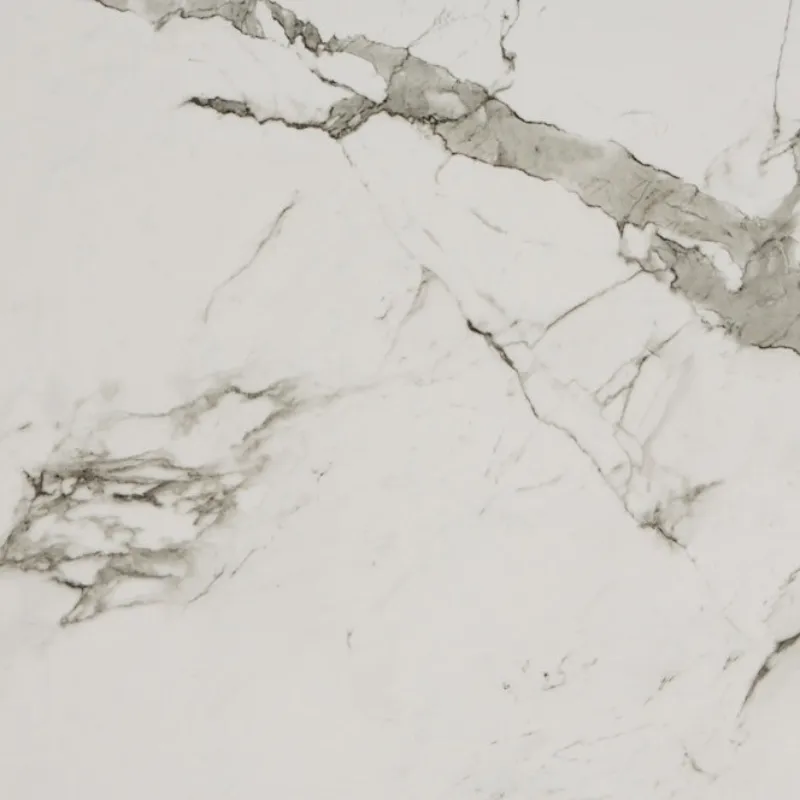
Porcelain has become one of the most requested premium surfaces over the past decade because the same slab can go on a kitchen island, a full-height backsplash, an outdoor barbecue surround or a wall. Looks range from clean solids and concrete to marble and wood-grain effects.
Brands our clients ask about in this category include Dekton, Neolith, Porcelanosa XTONE, Laminam, Lapitec, Florim and Daltile. Several of them are made in Spain or Italy, and their products and terms differ, so we compare the exact product line for your project.
Side by side
Porcelain Compared with Other Countertop Surfaces
| Criterion | Porcelain | Engineered quartz | Quartzite | Granite | Sintered stone |
|---|---|---|---|---|---|
| Composition | Ceramic clay and minerals, fired | Mostly ground quartz bound with resin | Natural metamorphic stone | Natural igneous stone | Sintered minerals, no resin |
| Sealing | Never | Never | Periodic | Periodic | Never |
| Heat | Very high | Lower: use a trivet | Very high | Very high | Very high |
| Outdoor and UV | Suited to outdoor use | Most brands indoor only | Yes, with care | Yes | Suited to outdoor use |
| Look | Solids, marble, concrete, wood | Consistent engineered patterns | Natural veining, one of a kind | Granular, natural | Consistent engineered patterns |
| Best for | Outdoor kitchens, modern and full-height work | All-around kitchens and baths | Statement kitchens and baths | Heat-heavy kitchens, outdoor | Outdoor and heavy-duty surfaces |
Choosing porcelain
Choosing Porcelain for a Seattle-Area Project
Start with where the slab will live. Porcelain is UV-stable and handles freeze and thaw, so Pacific Northwest rain, winter frost and summer sun are not a problem for outdoor kitchens, barbecue surrounds and fire pit surrounds.
Porcelain is also the thinnest surface we work with. Thin slabs keep weight down in renovations and work well for cladding and cabinet face panels, while thicker slabs suit busy kitchens. An edge build-up gives a thin slab the look of a thicker counter.
Brands differ in what they do best: some lead on outdoor-rated and very thin slabs, others on book-matched marble looks, large formats, design range or cladding. Tell us how the surface will be used and we will match the brand and thickness to it, then arrange a viewing of full slabs.
Care
Caring for Porcelain Countertops
- Daily cleaning is soap and water; porcelain resists stains, etching and bacteria.
- Avoid abrasive cleaners and steel wool, which can dull a polished finish.
- Polished finishes keep their shine with occasional buffing; matte and textured finishes need nothing beyond regular cleaning.
- No sealing, ever: the fired surface is non-porous.
Questions
Porcelain: Your Questions Answered
Interested in Porcelain? Get a free quote
Share photos, rough sizes and the material you like. We will help you take the next step.